How much sunscreen to use, when to reapply, and why most people apply too little
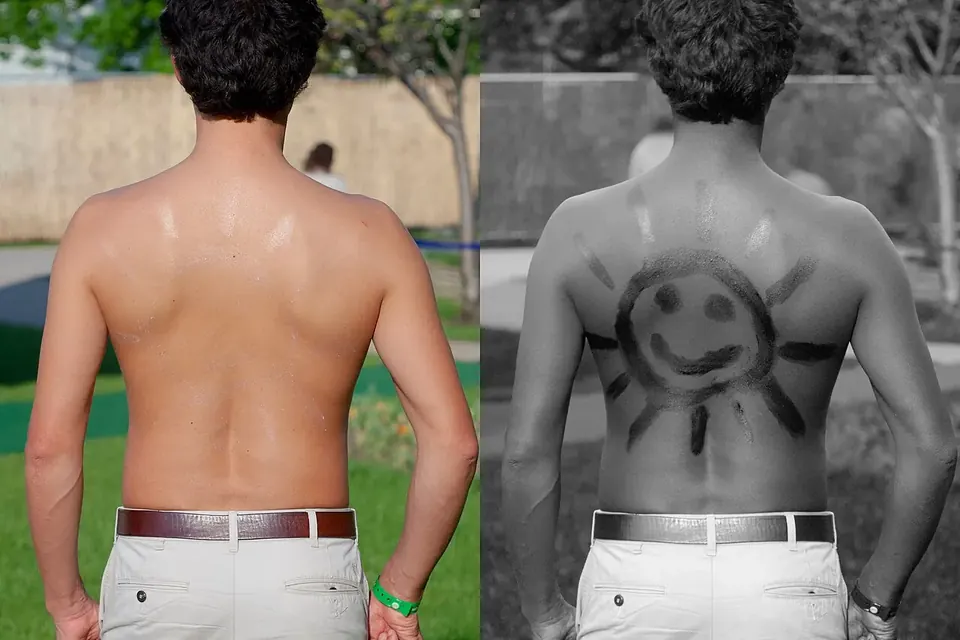
The number on a sunscreen bottle is measured under laboratory conditions, with a thick, even layer of product. Real people, studies consistently find, apply much less, miss areas and rarely reapply. The result is that an "SPF 50" often performs like a much lower number on the beach. Getting the amount right is the cheapest improvement you can make to any skincare routine.
- SPF is tested at 2 mg of sunscreen per cm² of skin.
- For the face and neck, that is roughly half a teaspoon, according to the widely used "teaspoon rule". For the whole body, about an ounce (30 ml), the amount of a shot glass, as the AAD and FDA advise.
- Reapply at least every two hours outdoors, and immediately after swimming or heavy sweating, whatever the water-resistance claim.
- Apply about 15 minutes before going out, and don't forget ears, neck, the back of the hands, the feet and the lips (SPF 30 lip balm).
Why the amount matters so much
SPF testing uses 2 milligrams per square centimetre because it gives reproducible results. A review of the research by Petersen and Wulf (2014) found that people in real life typically apply well below that amount, often half or less. Protection falls with the amount applied: thinner layers give a much lower effective SPF than the label. Sun exposure also wears sunscreen away: sweating, swimming, towelling and touching the face all remove it.
That is why dermatologists recommend SPF 30 or higher even though SPF 15 sounds sufficient on paper: it builds in a margin for real-world underapplication.
How much, in practice
| Area | Amount | Visual guide |
|---|---|---|
| Face and neck | About half a teaspoon | One finger-length of lotion, or a little more |
| Each arm | About a teaspoon | Two finger-lengths |
| Each leg, the chest and abdomen, the back | About two teaspoons each | Four finger-lengths |
| Whole body (adult) | About 30 ml (1 ounce) | A shot glass |
The figures follow the "teaspoon rule" proposed by Schneider (2002) to reach roughly the tested amount; the AAD's simpler advice is about an ounce for the whole body. They are approximations; what matters is applying a visible, even layer and rubbing it in fully. A 50 ml tube used correctly on the whole body lasts only one or two beach days, which is one way to check yourself.
When and how to reapply
- Apply 15 minutes before going out, as the FDA advises, on dry skin, as the last skincare step.
- Reapply at least every two hours while outdoors.
- Reapply straight after swimming, sweating or towelling. "Water resistant (40 minutes)" or "(80 minutes)" tells you how long protection held in a water test, not how long you can skip reapplying in real life.
- Indoors near windows or on a short commute, one morning application is usually enough; reapply before a long time outside.
Reapplying over makeup is the hardest part of daily sun protection. Sunscreen sticks, sprays held close and rubbed in, cushion compacts with SPF and powders with SPF can top up protection, but powders and compacts are rarely applied thickly enough to deliver the labelled SPF on their own. Treat them as top-ups after a proper morning layer.
Common misses
- Ears, the back of the neck and the hairline.
- Eyelids and around the eyes: a mineral stick is often easier and stings less.
- The scalp along a parting, or use a hat.
- The back of the hands, especially for drivers and cyclists.
- Lips: a lip balm with SPF 30 or higher.
- Feet, with sandals.
Special situations
- Using an AHA or retinoid. Both can increase sun sensitivity. The FDA advises sun protection while using an alpha hydroxy acid product and for a week afterwards; see our guide to a 10% lactic acid serum.
- Babies under 6 months. The FDA advises keeping them out of the sun and asking a doctor before using sunscreen.
- Hot, humid climates. Sweat and humidity remove sunscreen quickly. See skincare in a hot, humid climate.
- Altitude, snow and water. UV is stronger at altitude, and snow, sand and water reflect it back onto the skin.
Sunscreen is one layer of protection
The FDA and dermatologists recommend sunscreen as part of a wider approach: seek shade, especially in the middle of the day when UV is strongest; wear clothing that covers the skin, a wide-brimmed hat and UV-blocking sunglasses; and check the UV Index. No sunscreen blocks all UV.
Sprays, sticks and powders
Spray sunscreens make it easy to miss areas and to apply too little, and they can be blown away in the wind. The American Academy of Dermatology's advice for sprays is to spray until the skin glistens and then rub the product in, and not to spray directly onto the face: spray into your hands first and apply. Sticks are convenient for the face, ears and the backs of the hands, but need several passes over each area to deposit a meaningful layer. Powders with SPF are useful top-ups over makeup, not a main layer.
Expiry and storage
US sunscreens must carry an expiry date unless stability testing shows they last at least three years; the FDA says that a sunscreen without an expiry date should be considered expired three years after purchase. Heat degrades sunscreens faster: don't keep the bottle in a hot car or in direct sun on the beach; wrap it in a towel or keep it in the shade. Discard sunscreen that has separated, changed colour or smells off. Our comparison of US, European and Asian sunscreens explains the different labels you may find.
Sources
- US Food and Drug Administration, "Sunscreen: How to Help Protect Your Skin from the Sun" and "Tips to Stay Safe in the Sun: From Sunscreen to Sunglasses", FDA, consulted October 2026.
- American Academy of Dermatology, "How to apply sunscreen" and "How to select a sunscreen", AAD, consulted October 2026.
- Schneider J., "The teaspoon rule of applying sunscreen", Archives of Dermatology, 2002.
- Petersen B., Wulf H.C., "Application of sunscreen – theory and reality", Photodermatology, Photoimmunology & Photomedicine, 2014.
- US Food and Drug Administration, "Alpha Hydroxy Acids", FDA, consulted October 2026.
 US and Asian skincare
US, European and Asian sunscreens compared
Why a Korean SPF 50+ PA++++ and a US 'broad spectrum SPF 50' are labelled so differently, and what the filters are.
 Routines by skin type
Skincare in a hot, humid climate
Light textures, sweat-proof sunscreen habits, heat rash and the dry office air nobody expects in the tropics.
 Ingredients
Peach & Lily Power Cocktail, decoded
A 10% lactic acid serum read from its label: AHA strength, pH, sensitivity and the sunscreen rule.